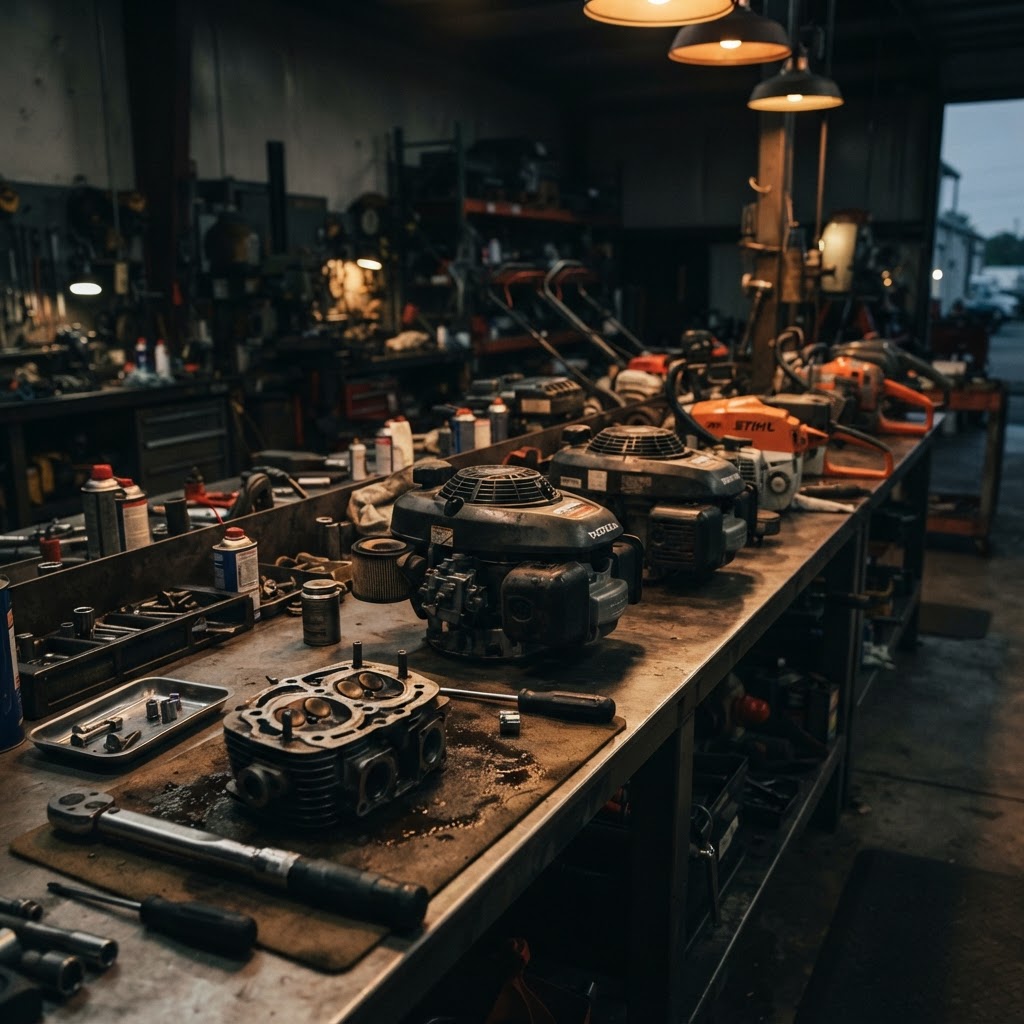
The reference desk your whole crew actually uses
OEM-cited specifications, ranked diagnostics, service intervals and operator-exposure guidance for small engines up to 2000cc — plus per-engine service logs your crew can fill in from the machine and you can export when a client or warranty claim asks for proof.
Every technical record carries its source citation and verification status — so you can check our work.
118
Engine spec sheets
Brand, bore/stroke, clearances, torque
105
Diagnostic guides
Ranked causes, DIY vs shop cost
48
Service procedures
Interval, spec, cost of neglect
34
Training modules
Sequenced, with self-checks
Live counts from the working database — growing continuously, each record carrying its own source citation and verification status.
Built for the people who bill for uptime
A landscaping crew, a rental yard, a municipal shop and a marine dealer all lose money the same way — equipment down in the middle of a paid job. Here is what changes that.
Cut unplanned downtime
Most small-engine failures in commercial service trace back to four things: stale ethanol-blended fuel, a clogged air filter, neglected oil, and a loose or damaged blade/drive component. All four are cheap to prevent and expensive to repair. A written interval program plus logged compliance removes the guesswork from a crew that changes hands seasonally.
Standardize crew knowledge
A seasonal crew arrives with wildly uneven skill. The learning library moves a new hire from 'never opened a carburetor' to competent field service on a defined track, with self-check questions and hands-on exercises so a supervisor can verify comprehension instead of assuming it.
Defensible service records
Every logged service captures engine, date, hour-meter reading, service type, and notes, and exports to CSV. That record is what supports a warranty claim, satisfies a client contract that specifies maintained equipment, and answers a question about who serviced what and when.
Occupational exposure documentation
Hand-arm vibration and noise from handheld two-stroke equipment are regulated exposures, not comfort issues. The ergonomics reference carries published exposure limits and duty-cycle guidance so you can build rotation schedules and keep the assessment paperwork an inspector or insurer may ask for.
The engine reference, in the open
No signup wall on this page. This is the core knowledge that keeps small engines alive in commercial service — read it, print it, hand it to a crew chief.
Engine oil (4-stroke, air-cooled)
Every 50 h, or annually
First change at 5–8 h on a new engine. Air-cooled engines run hot and shear oil faster than automotive service.
Oil filter (where fitted)
Every 100 h
Many small engines have no filter at all — that makes the drain interval more critical, not less.
Air filter — paper element
Inspect 25 h / replace 100–300 h
Replace far sooner in dusty or mowing work. Never oil a paper element and never wash it.
Air filter — foam pre-cleaner
Clean every 25 h
Wash, dry fully, then re-oil lightly with engine oil. A dry foam element passes dust straight through.
Spark plug
Every 100–200 h or annually
Set gap to the OEM figure. Reading the old plug is free diagnostic information — don't discard it before you look.
Valve clearance (OHV)
Every 200–300 h
Drifting clearance is a leading cause of hard starting and power loss on high-hour OHV engines.
Fuel filter / fuel lines
Annually
Ethanol-blended fuel hardens and cracks older line material. Inspect for weeping at every service.
Cooling fins & shrouds
Every 100 h
Packed debris causes overheating that reads like an oil or fuel problem. Clean before you diagnose.
Blades / cutting components
Sharpen 20–25 h
A dull blade loads the engine, wastes fuel, and tears rather than cuts.
Fuel system for storage
Before any 30+ day layup
The single highest-payback item in a seasonal fleet.
Baseline figures for typical commercial duty. Always defer to the OEM manual for a specific engine, and shorten intervals for dusty, hot or continuous-load work.
How to stand up a fleet maintenance program
Six steps, in order. Most shops already do three of them informally — the gain comes from making all six written and consistent.
Inventory and tag every unit
You cannot manage what you have not counted. Record brand, model, displacement, purchase date and hour-meter baseline for each unit, and give each one a durable physical tag that matches its record. Untagged equipment is why service history gets attributed to the wrong machine.
Set intervals from the OEM manual, not from habit
Pull the actual figures for each model in your fleet. Where your duty cycle is harsher than the manual assumes — dust, heat, continuous load, commercial hours — shorten the interval deliberately and write down why.
Track hours, not calendar dates alone
A commercial mower can accumulate a season of residential hours in two weeks. Hour-meter-based intervals with a calendar backstop, whichever comes first, is the standard that holds up.
Make logging take under a minute
If recording a service is slower than performing it, your crew will stop recording. Log at the machine on a phone, with voice entry where typing is impractical, and reminders pushed to the calendar the crew already uses.
Separate diagnosis from repair authority
Let field crews diagnose and document, and define clearly which repairs they perform versus which get escalated. A ranked-cause diagnostic with cost estimates lets a supervisor make the repair-or-replace call with actual numbers.
Review the data each season
Recurring failures across a model line are a purchasing signal, not just a maintenance one. Fleets that review their own service history stop rebuying equipment that has already proven itself expensive.
Operator safety & occupational exposure
These are regulated exposures with published limits — not comfort preferences. Employers are generally expected to assess them and keep records.
Non-negotiables
- Disconnect the spark plug lead before working near any blade, chain or drive component. An engine can fire from a single rotation.
- Never bypass or defeat an operator-presence control, blade brake, or kill switch. These exist because of specific documented injuries.
- Treat a recoil starter as stored energy. Release it under control and keep your face clear of the housing.
- Never run an engine indoors or in a partly enclosed space. Carbon monoxide is lethal and gives no warning.
- Let the engine cool fully before refueling, and refuel outdoors away from any ignition source.
- Pressure vessels — steam boilers and any external-combustion equipment — are outside DIY scope. Inspection, testing and repair belong to a certified professional.
Noise
Most handheld two-stroke equipment operates well above 85 dBA at the operator's ear, and many units exceed 100 dBA. In the US, OSHA sets a 90 dBA permissible exposure limit averaged over 8 hours with a 5 dB exchange rate, and requires a hearing conservation program at an 85 dBA action level. Because the limit is time-weighted, exposure time is a control: rotating operators and shortening continuous run time genuinely reduces dose. Hearing protection is the last line of defense, not the first.
Hand-arm vibration
Sustained vibration from handheld equipment causes hand-arm vibration syndrome — permanent nerve and vascular damage that begins as tingling, numbness and blanching fingers. The EU sets a daily action value of 2.5 m/s² A(8) and a limit value of 5 m/s²; ACGIH publishes comparable threshold values. High-vibration tools can reach the daily limit in well under an hour of trigger time, which is why anti-vibration mounts, sharp cutting tools, a light grip and enforced rotation matter more than tolerance.
Carbon monoxide
Small gasoline engines produce carbon monoxide in concentrations that are lethal indoors, and this kills people every year in garages, basements and partly enclosed spaces. It is colorless and odorless, and it does not become safe with an open door or a fan. Never run an engine in an enclosed or partly enclosed space, including for brief testing.
Fuel, exhaust and thermal hazards
Gasoline vapor is heavier than air and pools at floor level near ignition sources. Exhaust from small engines contains benzene and other constituents identified as carcinogens. Mufflers and cylinder fins reach temperatures that cause immediate contact burns and can ignite dry grass. Let equipment cool before refueling — every time, without exception.
What this reference is grounded in
- ·OEM service and operator manuals for each covered engine family, cited per record
- ·SAE standards for lubricant viscosity grades and engine test practice
- ·API and JASO/ISO oil service classifications for four-stroke and air-cooled two-stroke service
- ·OSHA 29 CFR 1910.95 for occupational noise exposure limits
- ·EU Directive 2002/44/EC and ACGIH TLVs for hand-arm vibration exposure values
- ·ANSI/OPEI equipment safety standards for outdoor power equipment
Regulatory limits and standards are summarized here for planning purposes and change over time. Confirm the current requirements for your jurisdiction, and always follow the OEM manual for a specific engine.
Fleet & Enterprise
Team access, shared logs, and priority support for fleets & shops.
$249/month
- Per-engine sharing so a supervisor sees a crew member's logs and reports
- CSV export of the full service history for contracts, warranty and audits
- Service reminders pushed to the calendar your team already runs on
- AI Mechanic grounded in the verified database, not open-ended guessing
Monthly or annual billing, cancel anytime from your account. Questions about a larger deployment? Reach out before you buy.

